
Meta Title: Premium Wall Tiles for Modern Interiors | Marhaba Home
Meta Description: Explore high-performance wall tiles at marhabatile.com. Marhaba Home provides durable, water-resistant ceramic and porcelain wall tiles for every space.
Architectural Precision & Vertical Surface Design: The Complete Guide to Wall Tiles by Marhaba Home
Vertical surfaces define how light, acoustic depth, and spatial geometry interact within modern residential and commercial spaces. Selecting premium wall tiles goes far beyond basic surface styling—it serves as a critical structural barrier against moisture intrusion, thermal fluctuation, and daily mechanical wear. Available through Marhaba Home curates precision-engineered collections that unite architectural durability with refined interior design.
Core Material Performance & Engineering
Matching material composition to specific environmental demands guarantees long-term durability, structural integrity, and low maintenance.
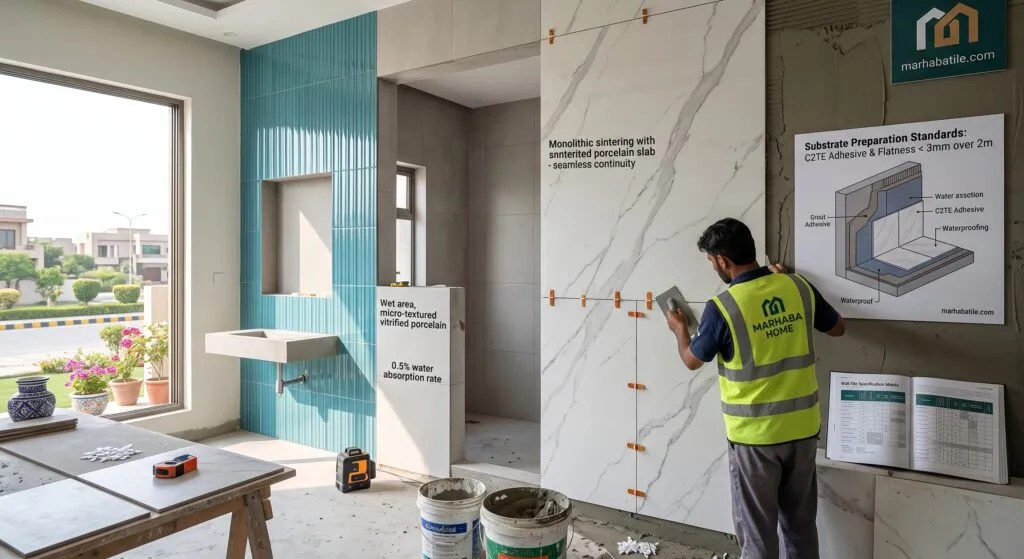
Vitrified Porcelain: Fired at extreme temperatures exceeding 1200°C, porcelain achieves an ultra-dense body with water absorption rates below 0.5%. This near-zero porosity prevents water damage, structural cracking, and moisture-driven bacterial growth, making it the superior choice for walk-in shower enclosures, wet zones, and exterior building facades.
Glazed Ceramic: Engineered with a lighter biscuit body that reduces dead load on vertical framing, drywall, and masonry substrates, glazed ceramic ensures swift, secure installation. Its vitrified liquid glaze creates an impenetrable barrier against food splatters, smoke, oil, and aggressive household cleaning agents.
Sintered Large-Format Slabs: Manufactured under extreme compaction pressure, large slabs eliminate dense grout networks. They deliver continuous marble veining and monolithic stone appeal across open-plan interiors, residential feature zones, and commercial lobbies.
Fluted & 3D Tactile Profiles: Three-dimensional relief surfaces manipulate natural and artificial lighting, casting rich shadow lines while delivering acoustic dampening across partition walls and living room focal points.
Wall Tile Specification Matrix
| Space / Application | Recommended Tile Material | Surface Finish | Primary Functional Objective |
| Kitchen Splashback | High-Grade Glazed Ceramic | High Gloss / Polished | Low surface friction for effortless degreasing and heat deflection |
| Shower & Wet Area | Vitrified Porcelain | Matte / Micro-Textured | Sub-0.5% water absorption, limescale resistance, structural rigidity |
| Living Room Accent Wall | Sintered Porcelain Slab | Satin / Honed | Monolithic appearance, seamless continuity, minimal joint lines |
| Vanity Niche & Powder Room | 3D Fluted / Relief Ceramic | Metallic / Deep Gloss | Multi-angle light refraction, acoustic dampening, sculptural relief |
| Commercial Feature Wall | Large-Format Rectified Porcelain | Semi-Polished / Lappato | High abrasion resistance, uniform aesthetic, easy sanitization |
Spatial Geometry and Optical Dynamics
The finish, format, and orientation of vertical tile installations directly shape how room dimensions and lighting are perceived:
Light Amplification: High-gloss finishes bounce ambient and artificial light across opposing walls, significantly expanding the visual footprint of compact powder rooms and narrow corridors.
Glare Diffusion: Matte and satin surfaces scatter illumination across the wall plane, eliminating harsh reflections while concealing water spots, soap residue, and handling marks.
Vertical Expansion: Installing rectangular subway or plank tiles vertically draws the eye upward to increase perceived ceiling height in low-clearance spaces.
Horizontal Widening: Horizontal stacked or running-bond configurations visually elongate short spaces, making tight entryways, utility areas, and galley kitchens appear broader.
Substrate Preparation and Installation Standards
A long-lasting wall installation relies on strict substrate preparation and adhesive application standards before setting begins:
Substrate Flatness: Vertical surfaces must not exceed an unevenness of 3 mm over a 2-meter straight edge to eliminate visible lippage across joint lines.
Adhesive Classification: Use polymer-modified thin-set mortars classified as C2TE (cementitious, improved adhesion, slip-resistant, extended open time) to prevent heavy tiles from sliding down vertical planes during curing.
Grout Joint Standards: Rectified tiles allow narrow joints between 1.5 mm and 2 mm, while traditional pressed-edge tiles require 3 mm joints to accommodate natural firing tolerances.
Waterproofing Interlayers: Apply continuous liquid-membrane or sheet waterproofing behind adhesive beds in all direct-exposure wet areas to prevent structural dampness.
Long-Term Maintenance and Longevity
High-performance ceramic and porcelain surfaces require minimal maintenance compared to raw stone or painted walls:
Daily Cleaning: Wipe surfaces with a neutral pH cleaner and microfibre cloth to remove surface dust without stripping protective glazes.
Grout Sealing: Apply penetrating grout sealers annually in wet zones to prevent discoloration, mildew formation, and efflorescence.
Chemical Resistance: Glazed surfaces resist chemical staining from acidic cooking agents, cosmetics, and sanitizing solutions, ensuring that vibrant finishes remain intact over decades.
Explore the complete catalog to source precision-engineered Marhaba Home wall solutions designed for lasting performance and refined architectural appeal.